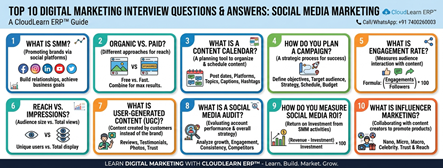
Top 10 Digital Marketing Interview Questions & Answers on Social Media Marketing

Social Media Marketing (SMM) has become one of the most powerful digital marketing strategies for businesses to connect with their audience, build brand awareness, generate leads, and drive sales. With billions of active users across platforms like Facebook, Instagram, LinkedIn, YouTube, and X (formerly Twitter), companies of all sizes are investing heavily in social media to grow their online presence.
If you’re preparing for a Digital Marketing Interview, understanding Social Media Marketing concepts is essential. In this blog, we’ll cover the Top 10 Social Media Marketing Interview Questions and Answers that are frequently asked by recruiters and hiring managers.
1. What is Social Media Marketing?
Answer:
Social Media Marketing (SMM) is the process of promoting brands, products, or services through social media platforms to engage audiences, build relationships, and achieve business goals.
Popular Social Media Platforms
- YouTube
- X (Twitter)
Main Objectives of Social Media Marketing
- Brand Awareness
- Audience Engagement
- Lead Generation
- Website Traffic
- Sales & Conversions
Social media marketing includes both organic content and paid advertising to maximize reach and business growth.
2. What is the Difference Between Organic and Paid Social Media?
Organic Social Media
Organic social refers to unpaid content published on social media platforms.
Examples
- Regular posts
- Stories
- Reels
- Community engagement
- Live videos
Benefits
- Builds customer trust
- Strengthens audience relationships
- Supports long-term brand growth
- Cost-effective marketing
Paid Social Media
Paid social involves running advertisements on social media platforms to reach targeted audiences.
Examples
- Sponsored posts
- Video advertisements
- Lead generation campaigns
- Carousel ads
- Story ads
Benefits
- Faster audience reach
- Advanced audience targeting
- Higher scalability
- Better conversion opportunities
Most successful businesses combine both organic and paid strategies for maximum results.
3. What is a Content Calendar?
Answer:
A content calendar is a planning tool used to organize and schedule social media content before publication.
It Typically Includes
- Content topics
- Posting dates
- Social media platforms
- Captions
- Hashtags
- Campaign objectives
Benefits
- Maintains consistency
- Improves planning
- Enhances team collaboration
- Saves time
- Ensures organized marketing campaigns
A content calendar helps marketers execute a structured and consistent social media strategy.
4. How Do You Plan a Social Media Campaign?
Answer:
Planning a successful social media campaign involves several strategic steps.
Campaign Planning Process
- Define campaign objectives
- Identify the target audience
- Select appropriate social media platforms
- Develop a content strategy
- Create a posting schedule
- Allocate advertising budget
- Launch the campaign
- Monitor performance and optimize
Important Campaign KPIs
- Reach
- Engagement
- Click-Through Rate (CTR)
- Conversions
- Return on Investment (ROI)
A successful campaign combines creativity, audience targeting, and continuous performance analysis.
5. What is Engagement Rate?
Answer:
Engagement Rate measures how actively users interact with your social media content.
Common Engagement Actions
- Likes
- Comments
- Shares
- Saves
- Clicks
Formula
Engagement Rate = (Total Engagements ÷ Total Followers or Reach) × 100
A higher engagement rate indicates that your content is relevant, valuable, and resonates well with your audience.
6. What is the Difference Between Reach and Impressions?
Reach
Reach refers to the number of unique users who see your content.
Impressions
Impressions represent the total number of times your content is displayed, including multiple views by the same user.
Example
If 100 people view your post twice:
- Reach = 100
- Impressions = 200
Key Difference
- Reach measures audience size.
- Impressions measure total exposure.
7. What is User-Generated Content (UGC)?
Answer:
User-Generated Content (UGC) is content created by customers or users instead of the brand itself.
Examples
- Customer reviews
- Testimonials
- Product unboxing videos
- Customer photos
- Social media mentions
Benefits
- Builds trust
- Increases authenticity
- Improves engagement
- Encourages community participation
UGC is highly effective because people trust real customer experiences more than traditional advertising.
8. What is a Social Media Audit?
Answer:
A social media audit is the process of evaluating the performance of your social media accounts and overall strategy.
Areas Analyzed
- Profile optimization
- Audience growth
- Engagement metrics
- Content performance
- Posting consistency
- Competitor analysis
Goal
A social media audit helps identify strengths, weaknesses, and opportunities to improve future marketing performance.
9. How Do You Measure Social Media ROI?
Answer:
Social Media ROI (Return on Investment) measures the value generated from social media activities compared to the resources invested.
Common ROI Metrics
- Leads generated
- Sales revenue
- Website traffic
- Customer engagement
- Brand awareness
- Customer acquisition cost
Formula
ROI = (Revenue − Investment) ÷ Investment × 100
Measuring ROI enables businesses to determine whether their social media campaigns are delivering profitable results.
10. What is Influencer Marketing?
Answer:
Influencer marketing is a digital marketing strategy where brands collaborate with social media influencers or content creators to promote products or services.
Types of Influencers
- Nano Influencers
- Micro Influencers
- Macro Influencers
- Celebrity Influencers
Benefits
- Builds audience trust
- Increases engagement
- Expands brand awareness
- Reaches highly targeted audiences
Popular Platforms
- YouTube
- TikTok
Influencer marketing delivers the best results when an influencer’s audience closely matches the brand’s target market.
Key Takeaways
Social Media Marketing is an essential component of every modern digital marketing strategy. Mastering concepts like organic vs. paid social, content calendars, campaign planning, engagement metrics, reach, impressions, UGC, social media audits, ROI, and influencer marketing will not only help you succeed in interviews but also enable you to create impactful campaigns in the real world.
As businesses continue to invest in digital channels, skilled social media marketers are in high demand across industries.
By CloudLearn ERP™
📞 Call/WhatsApp: +91 7400260003
Learn Digital Marketing with CloudLearn ERP™
At CloudLearn ERP™, we offer industry-oriented Digital Marketing training designed to help students, professionals, entrepreneurs, and job seekers build successful careers in digital marketing.
Our Digital Marketing Course Covers:
- Search Engine Optimization (SEO)
- Google Ads (SEM)
- Social Media Marketing (SMM)
- Content Marketing
- Email Marketing & Automation
- Performance Marketing
- Google Analytics (GA4)
- AI Tools for Digital Marketing
- Lead Generation
- CRM & Marketing Automation
- Live Projects & Interview Preparation
Our practical, hands-on approach ensures you gain the skills needed to excel in today’s competitive digital marketing landscape.
📞 Contact: +91 7400260003
CloudLearn ERP™
Learn. Build. Market. Grow Your Digital Career.
