Loop Engineering: The Future of AI-Native Product Development

Artificial Intelligence is fundamentally changing how software products are designed, developed, tested, and launched. We’re moving beyond traditional software engineering into an era where AI is no longer just a coding assistant—it is an active collaborator throughout the product development lifecycle.
One of the most exciting concepts emerging from this transformation is Loop Engineering.
Rather than viewing product development as a linear process, Loop Engineering embraces a continuous cycle of building, learning, validating, and improving. It combines the strengths of AI agents, human creativity, and real-world customer feedback to accelerate innovation while improving product quality.
The organizations that master these continuous feedback loops will be the ones creating the next generation of breakthrough AI-native products.
What Is Loop Engineering?
Loop Engineering is an AI-driven product development methodology built around continuous improvement.
Instead of following the traditional sequence of planning, development, testing, deployment, and maintenance, Loop Engineering creates an ongoing cycle where every stage informs the next.
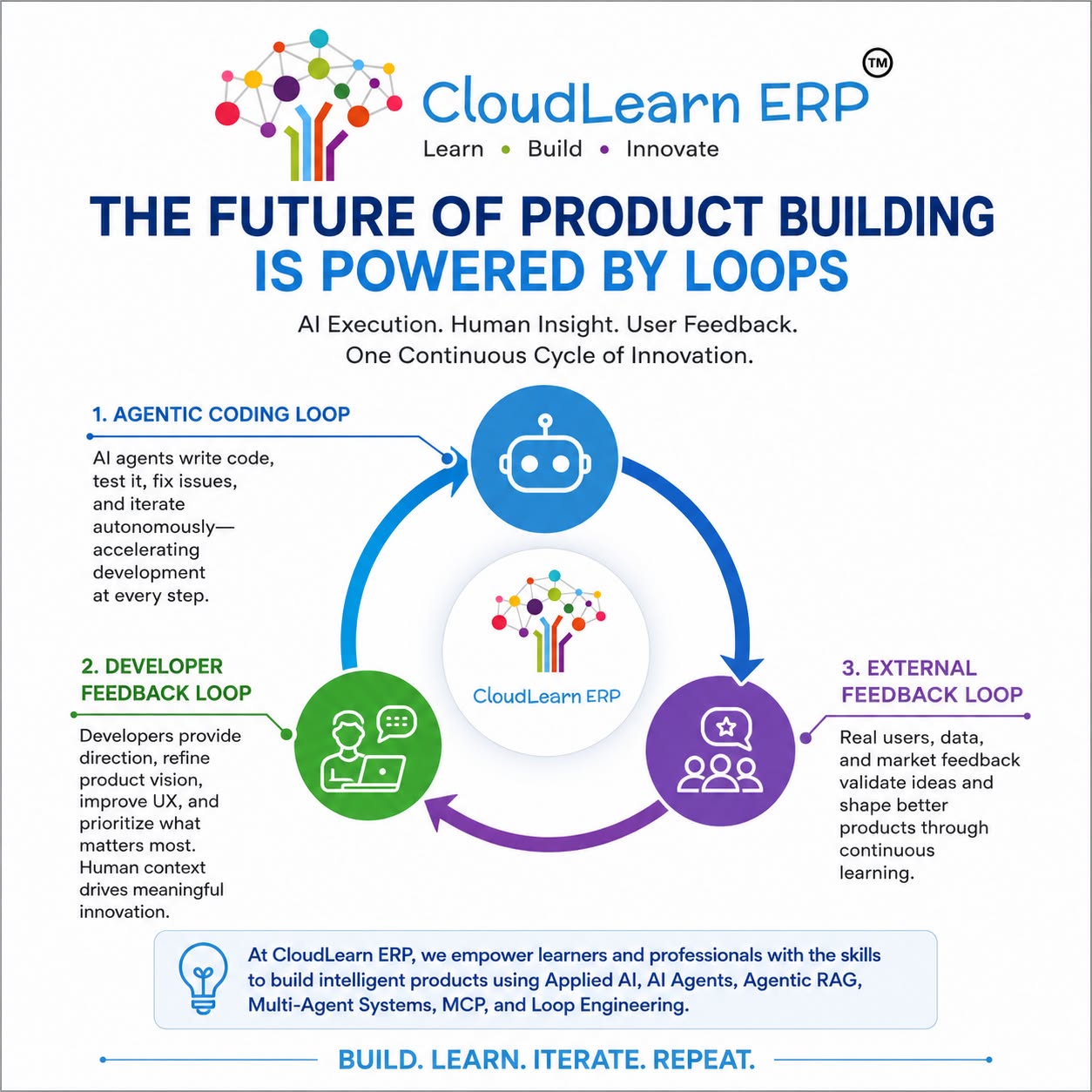
At its core are three interconnected feedback loops:
- 🔁 Agentic Coding Loop
- 🧠 Developer Feedback Loop
- 🌍 External Feedback Loop
Each loop plays a unique role in transforming ideas into successful AI-powered products.
1. The Agentic Coding Loop
The first loop is powered by intelligent AI agents.
Modern AI coding systems can do far more than generate snippets of code. They can:
- Write production-ready code
- Generate unit tests
- Detect bugs
- Refactor software
- Optimize performance
- Fix errors automatically
- Iterate continuously
Instead of waiting for developers to manually identify issues, AI agents constantly evaluate and improve the software.
This creates a continuous engineering cycle where implementation becomes dramatically faster.
Think of AI as an autonomous engineering teammate that never stops improving the codebase.
2. The Developer Feedback Loop
While AI excels at implementation, it lacks business intuition, strategic thinking, and deep customer understanding.
That’s where human developers become even more valuable.
In Loop Engineering, developers shift from writing every line of code to becoming product architects who:
- Define product vision
- Design user experiences
- Provide business context
- Review AI-generated solutions
- Make architectural decisions
- Refine specifications
- Ensure ethical AI implementation
Rather than replacing software engineers, AI elevates their role.
Developers become product thinkers who guide intelligent systems toward meaningful outcomes.
3. The External Feedback Loop
The final—and arguably most important—loop comes from real users.
No amount of AI-generated optimization can replace customer feedback.
Users validate assumptions by revealing:
- What works
- What doesn’t
- Which features matter most
- Unexpected use cases
- Pain points
- Product opportunities
This feedback flows directly back into development, enabling both AI agents and human teams to continuously refine the product.
The result is software that evolves based on real-world experience rather than assumptions.
Why Loop Engineering Matters
The biggest breakthrough isn’t simply faster coding.
It’s the ability to move seamlessly between:
- Building
- Learning
- Improving
- Validating
- Iterating
This continuous cycle dramatically reduces development time while increasing product quality.
Instead of releasing software once every few months, AI-native teams can iterate daily—or even hourly.
The Changing Role of Software Engineers
As AI agents automate more implementation work, the role of software engineers is evolving.
Tomorrow’s engineers will spend less time writing repetitive code and more time:
- Solving business problems
- Designing AI workflows
- Defining product strategy
- Managing AI agents
- Understanding customer needs
- Creating better user experiences
- Building intelligent systems
The future software engineer is no longer just a programmer.
They are an AI-enabled product innovator.
From Coding to Product Thinking
The traditional engineering mindset focused on:
- Writing code
- Fixing bugs
- Delivering features
The AI-native mindset focuses on:
- Solving customer problems
- Designing intelligent workflows
- Orchestrating AI agents
- Rapid experimentation
- Continuous innovation
The most successful teams won’t simply write software faster.
They’ll learn faster.
Building 0→1 Products in the AI Era
Creating a product from zero to one has always been one of the hardest challenges in technology.
Loop Engineering changes that.
By combining AI execution, human expertise, and customer validation, startups and enterprises can rapidly transform ideas into market-ready products.
Every iteration becomes smarter than the last.
This dramatically shortens the path from concept to production.
The Three Loops Working Together
Imagine launching a new AI-powered business application.
Step 1 — AI Builds
An AI coding agent generates the application’s backend, frontend, APIs, database models, documentation, and test cases.
Step 2 — Developers Improve
Product managers and engineers review the implementation, adjust business rules, refine workflows, and ensure the solution aligns with customer goals.
Step 3 — Customers Validate
Users begin interacting with the application.
Their behavior reveals:
- Missing features
- Better workflows
- Usability improvements
- New automation opportunities
Step 4 — AI Learns Again
AI agents incorporate this feedback into the next development cycle.
The loop continues.
Build.
Learn.
Iterate.
Repeat.
Why Businesses Should Embrace Loop Engineering
Organizations adopting Loop Engineering gain significant competitive advantages:
- Faster product development
- Continuous innovation
- Higher software quality
- Better customer experiences
- Reduced development costs
- Rapid experimentation
- Smarter AI-driven decision-making
- Faster time-to-market
Rather than releasing static software, businesses create products that continuously evolve with user needs.
Learn Loop Engineering with CloudLearn ERP™
At CloudLearn ERP™, we are preparing professionals for the next generation of AI-native software engineering through hands-on, industry-focused training.
Our programs cover:
- Applied Artificial Intelligence
- Agentic AI
- AI Agents
- Agentic RAG
- Multi-Agent Systems
- Model Context Protocol (MCP)
- Loop Engineering
- AI-Driven Software Engineering
- Prompt Engineering
- AI Product Development
Our practical curriculum equips learners with the skills needed to design, build, deploy, and continuously improve intelligent products—from idea to production.
The Future Belongs to Continuous Innovators
The future won’t belong to professionals who simply know how to code.
It will belong to those who can combine:
- AI execution
- Human insight
- Customer feedback
into a continuous innovation loop.
The teams that master Loop Engineering will build the next generation of AI-native products faster, smarter, and more effectively than ever before.
Final Thoughts
Artificial Intelligence is redefining software engineering—not by replacing developers, but by transforming how products are built.
Loop Engineering represents a powerful new paradigm where AI agents accelerate implementation, humans provide strategic direction, and users continuously shape product evolution.
In the AI era, speed matters—but speed without learning is not enough.
The winning formula is simple:
AI for Iteration + Humans for Context + Users for Truth.
Build. Learn. Iterate. Repeat.
That’s how the next generation of intelligent products will be created.
CloudLearn ERP™
📲 +91 7400260003
SEO Keywords
Loop Engineering, AI-Native Product Development, Agentic AI, AI Agents, Applied AI, AI Software Engineering, AI Product Development, Agentic RAG, Multi-Agent Systems, MCP, AI Automation, Generative AI, Future of Software Engineering, AI Innovation, CloudLearn ERP, AI Training, Product Engineering, Continuous Learning, Intelligent Automation.
