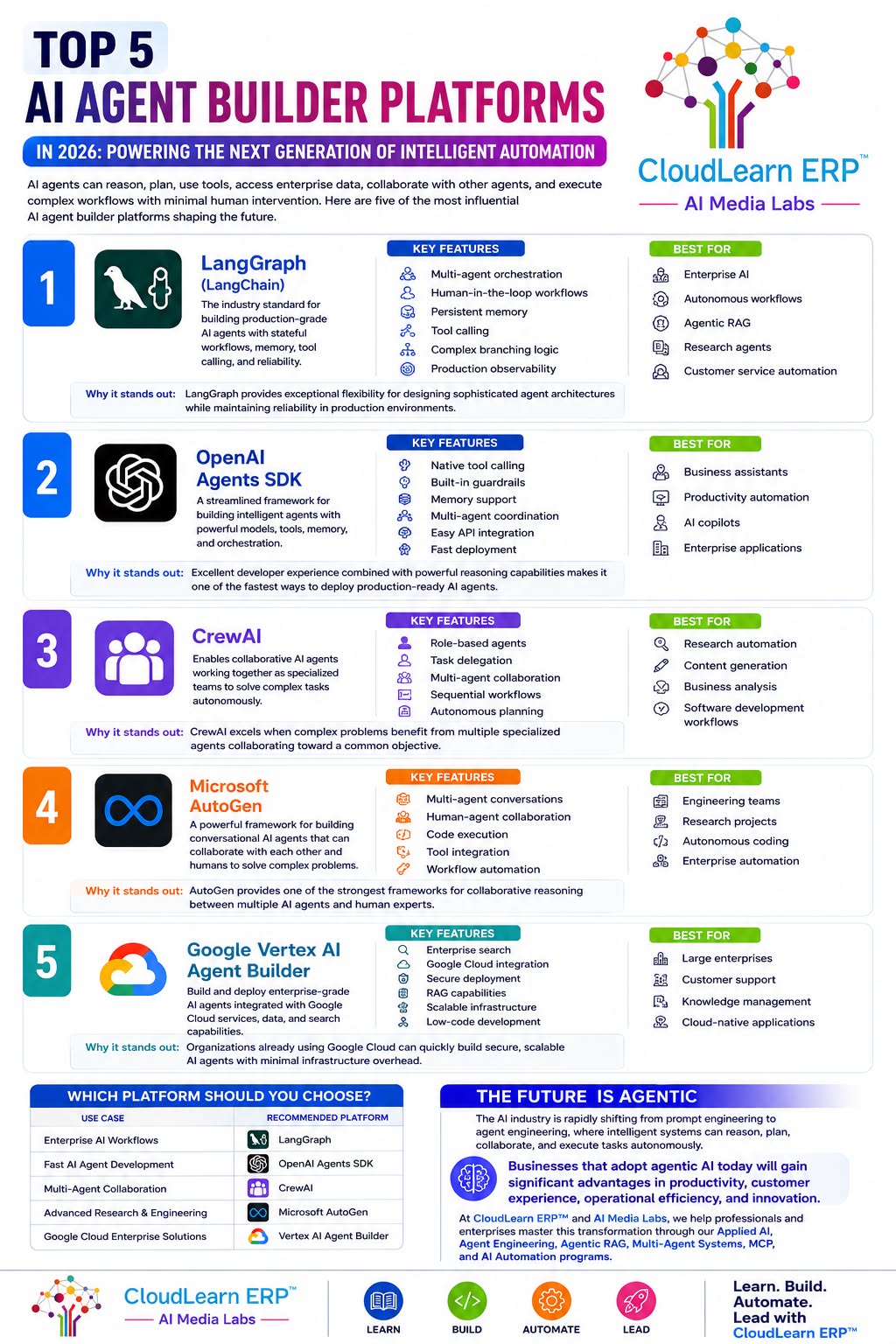
Top 5 AI Agent Builder Platforms in 2026: Powering the Next Generation of Intelligent Automation

Artificial Intelligence is entering a new era. The focus has shifted from simple chatbots and prompt-based interactions to AI agents—intelligent systems capable of reasoning, planning, using external tools, accessing enterprise data, collaborating with other agents, and autonomously completing complex tasks.
From customer support automation and AI-powered coding assistants to enterprise workflow orchestration and research automation, AI agents are rapidly becoming the backbone of modern digital transformation.
However, building production-ready AI agents requires the right platform. Whether you’re an AI engineer, software developer, startup founder, or enterprise architect, selecting the right AI agent framework can significantly impact scalability, reliability, and performance.
In this article, we explore the Top 5 AI Agent Builder Platforms in 2026 that are driving the next generation of intelligent automation.
1. LangGraph (LangChain)
LangGraph has emerged as one of the most powerful frameworks for building production-grade AI agents. Built on the LangChain ecosystem, it enables developers to design stateful, graph-based workflows where AI agents can reason, make decisions, recover from failures, call external tools, and maintain long-term memory.
Unlike traditional linear workflows, LangGraph allows developers to create complex branching logic and orchestrate multiple agents working together seamlessly.
Key Features
- Multi-agent orchestration
- Human-in-the-loop workflows
- Persistent memory
- Tool calling
- Complex branching logic
- Production observability
Best For
- Enterprise AI applications
- Autonomous workflows
- Agentic Retrieval-Augmented Generation (RAG)
- Research assistants
- Customer service automation
Why LangGraph Stands Out
LangGraph offers unmatched flexibility for designing sophisticated AI agent architectures while maintaining stability and reliability in enterprise production environments.
2. OpenAI Agents SDK
The OpenAI Agents SDK simplifies the development of intelligent AI agents powered by advanced language models. It provides developers with a streamlined framework for integrating tools, structured outputs, memory, and orchestration into AI applications.
Its developer-friendly architecture allows businesses to deploy AI assistants much faster while maintaining robust safety mechanisms through built-in guardrails.
Key Features
- Native tool calling
- Built-in guardrails
- Memory support
- Multi-agent coordination
- Easy API integration
- Rapid deployment
Best For
- Business assistants
- Productivity automation
- AI copilots
- Enterprise software
Why OpenAI Agents SDK Stands Out
Its excellent developer experience, powerful reasoning capabilities, and simplified deployment make it one of the fastest ways to build production-ready AI agents.
3. CrewAI
CrewAI introduced an innovative approach to AI automation by allowing multiple specialized AI agents to collaborate as a team.
Instead of relying on a single AI model, CrewAI assigns different responsibilities to agents such as:
- Researcher
- Business Analyst
- Developer
- Reviewer
- Content Writer
These agents work together autonomously to complete sophisticated workflows.
Key Features
- Role-based AI agents
- Task delegation
- Multi-agent collaboration
- Sequential workflows
- Autonomous planning
Best For
- Research automation
- Content generation
- Business intelligence
- Software development
Why CrewAI Stands Out
CrewAI excels when solving complex tasks that require multiple experts working collaboratively toward a shared objective.
4. Microsoft AutoGen
Developed by Microsoft Research, AutoGen has become one of the leading frameworks for enabling intelligent conversations between multiple AI agents and human users.
AutoGen is particularly effective for engineering, software development, scientific research, and autonomous coding environments where multiple agents collaborate to solve challenging problems.
Key Features
- Multi-agent conversations
- Human-agent collaboration
- Code execution
- Tool integration
- Workflow automation
Best For
- Engineering teams
- Scientific research
- Autonomous coding
- Enterprise workflow automation
Why Microsoft AutoGen Stands Out
AutoGen provides one of the strongest ecosystems for collaborative reasoning, enabling AI agents and humans to work together efficiently on complex projects.
5. Google Vertex AI Agent Builder
Google Cloud’s Vertex AI Agent Builder enables organizations to rapidly build secure, enterprise-grade AI agents tightly integrated with Google Cloud infrastructure.
With built-in enterprise search, Retrieval-Augmented Generation (RAG), scalable deployment, and low-code development capabilities, it is particularly attractive for organizations already operating within the Google Cloud ecosystem.
Key Features
- Enterprise search
- Google Cloud integration
- Secure deployment
- RAG capabilities
- Scalable infrastructure
- Low-code development
Best For
- Large enterprises
- Customer support automation
- Knowledge management
- Cloud-native AI applications
Why Vertex AI Agent Builder Stands Out
Businesses already using Google Cloud can rapidly deploy highly secure, scalable AI agents without significant infrastructure complexity.
Comparison Table
| Use Case | Recommended Platform |
|---|---|
| Enterprise AI Workflows | LangGraph |
| Fast AI Agent Development | OpenAI Agents SDK |
| Multi-Agent Collaboration | CrewAI |
| Advanced Research & Engineering | Microsoft AutoGen |
| Google Cloud Enterprise Solutions | Vertex AI Agent Builder |
The Future Is Agentic
Artificial Intelligence is rapidly evolving from Prompt Engineering to Agent Engineering.
Instead of simply responding to prompts, modern AI agents can:
- Reason intelligently
- Plan complex workflows
- Use external tools
- Access enterprise knowledge
- Collaborate with humans
- Coordinate with other AI agents
- Execute tasks autonomously
This shift is transforming industries across healthcare, finance, manufacturing, education, customer service, software development, and enterprise automation.
Organizations that embrace Agentic AI today will enjoy significant advantages in:
- Increased productivity
- Better customer experiences
- Lower operational costs
- Faster decision-making
- Enhanced innovation
- Scalable intelligent automation
The future belongs to businesses that build intelligent digital workforces—not just AI chatbots.
Learn Agent Engineering with CloudLearn ERP™ X AI Media Labs™
At CloudLearn ERP™ X AI Media Labs™, we empower professionals, developers, and enterprises to master the next generation of AI through industry-focused training programs.
Our specialized programs include:
- Applied Artificial Intelligence
- Agent Engineering
- Agentic RAG
- Multi-Agent Systems
- Model Context Protocol (MCP)
- AI Automation
- AI Copilot Development
- Prompt Engineering
- Generative AI for Enterprises
Whether you’re beginning your AI journey or building enterprise-grade intelligent automation solutions, our hands-on training prepares you for the future of AI.
Final Thoughts
AI agents are no longer a futuristic concept—they are transforming the way businesses operate today. Platforms like LangGraph, OpenAI Agents SDK, CrewAI, Microsoft AutoGen, and Google Vertex AI Agent Builder are leading this transformation by enabling developers to build smarter, more autonomous, and collaborative AI systems.
Choosing the right platform depends on your business goals, infrastructure, and technical requirements. Regardless of which framework you adopt, investing in agentic AI today will position your organization for long-term success in an increasingly automated world.
Learn. Build. Automate. Lead.
CloudLearn ERP™ X AI Media Labs™
📞 +91 7400001151

Hi, this is a comment.
To get started with moderating, editing, and deleting comments, please visit the Comments screen in the dashboard.
Commenter avatars come from Gravatar.